
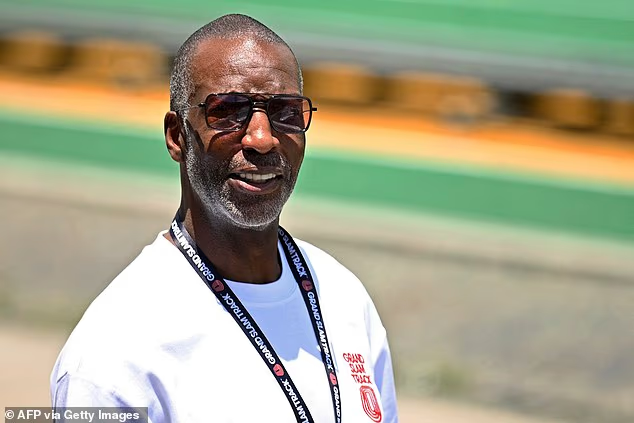
The future of Grand Slam Track has received a boost after American track stars Melissa Jefferson-Wooden, Kenny Bednarek and Freddie Crittenden submitted letters supporting the league’s proposed plan of reorganisation as it attempts to emerge from bankruptcy protection.
The athletes indicated in court filings that they would be willing to compete in the series again if it returns, offering an important vote of confidence for a project that has faced financial turbulence and legal scrutiny in recent months.

Launched by four-time Olympic champion Michael Johnson, the professional league was created to reshape the global track and field landscape by offering athletes guaranteed contracts, significant prize money and a series of high-profile competitions designed to showcase elite rivalries. The concept attracted global attention and a number of top athletes when it debuted in 2025, promising to create a sustainable professional circuit outside traditional championships.
Support from Jefferson-Wooden, Bednarek and Crittenden could prove significant for Grand Slam Track, which filed for Chapter 11 bankruptcy protection in late 2025 after financial challenges forced the cancellation of its planned season finale.

Melissa Jefferson-Wooden.. during the .GST in philly
The league ultimately staged three meets during its inaugural season before the financial difficulties halted further events. Bankruptcy protection was sought to allow the organisation to restructure debts and attempt a relaunch under a revised financial framework.
Court documents show the organisation listed liabilities in the range of tens of millions of dollars and identified numerous creditors, including athletes, event suppliers and production partners. The restructuring proposal seeks to reorganise those obligations while preserving the core concept of the competition series.

A key element of the proposed restructuring concerns how different creditors will be repaid. Under the current plan, athletes and certain key sporting stakeholders could receive around 85% of the money owed to them, reflecting the league’s priority to maintain relationships with competitors.
By contrast, some vendors and suppliers could receive significantly smaller repayments, a structure that has sparked frustration among certain creditors involved in staging the events.
Despite those tensions, the backing from prominent athletes signals that parts of the athlete community still believe in the concept behind Grand Slam Track. Jefferson-Wooden and Bednarek were among the notable competitors who appeared in the league’s inaugural meets, while Crittenden’s support adds weight from another established international athlete.

However, the restructuring process has also exposed divisions among those affected by the collapse. Several suppliers and service providers have expressed dissatisfaction with the repayment structure proposed in the bankruptcy proceedings. Some creditors argue that the current plan could leave them recovering only a fraction of the money owed, raising concerns about the financial risks associated with the league’s original rollout.
The controversy has also brought scrutiny toward Johnson’s leadership of the project. In legal filings submitted during the bankruptcy process, some creditors have alleged that certain financial decisions may have disadvantaged other stakeholders. Johnson has denied wrongdoing, maintaining that payments he received were reimbursements for personal funds he had invested into launching the league.

No court ruling has determined misconduct, and the allegations remain part of the ongoing legal dispute. For many athletes, however, the appeal of the concept remains strong. Professional track and field has long faced criticism for offering limited earning opportunities outside major championships such as the Olympic Games and the World Athletics Championships.
Johnson’s vision for the league was to create a commercially viable circuit where athletes could compete regularly while earning stable income through salaries and prize money.

Industry observers note that rebuilding trust with both athletes and vendors will be crucial if the series is to return. The support from Jefferson-Wooden, Bednarek and Crittenden may help strengthen the argument that athletes still see value in the competition format, even after the financial setback.
The bankruptcy court will ultimately determine whether the reorganisation plan is approved and whether Grand Slam Track can successfully restructure its debts. If the plan is confirmed, the league could potentially return with new investment, tighter financial controls and a revised schedule of events.

For now, the willingness of several elite athletes to publicly support the restructuring effort provides a measure of optimism. While challenges remain, their backing suggests that the idea behind Grand Slam Track—a dedicated professional circuit for the world’s fastest athletes—still resonates with competitors hoping for a stronger commercial future in the sport.
